
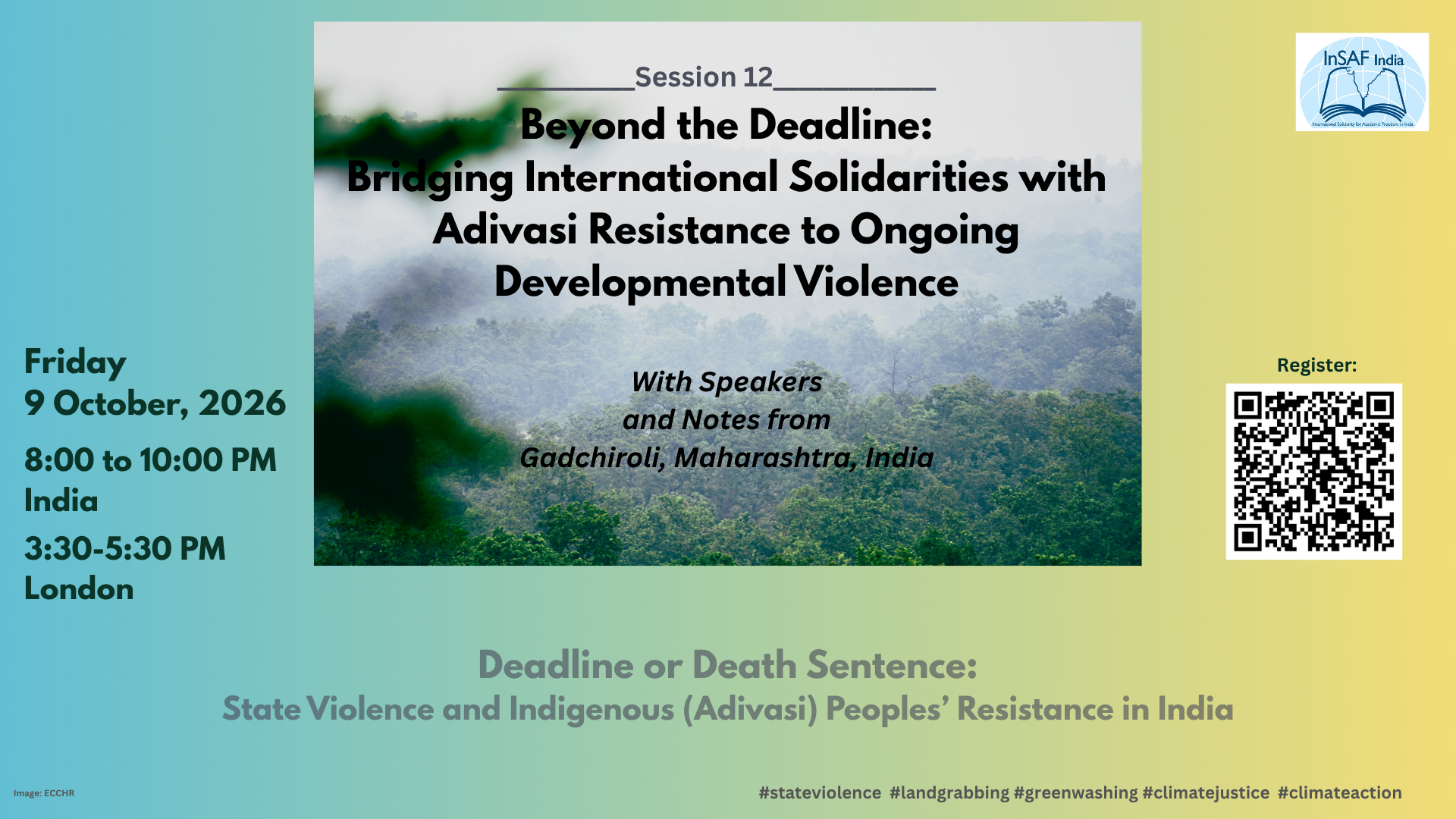
Session 12: Beyond the Deadline: Bridging International Solidarities with Adivasi Resistance to Ongoing Developmental Violence
9 October 2026 With Speakers and Notes from Gadchiroli, Maharashtra, India
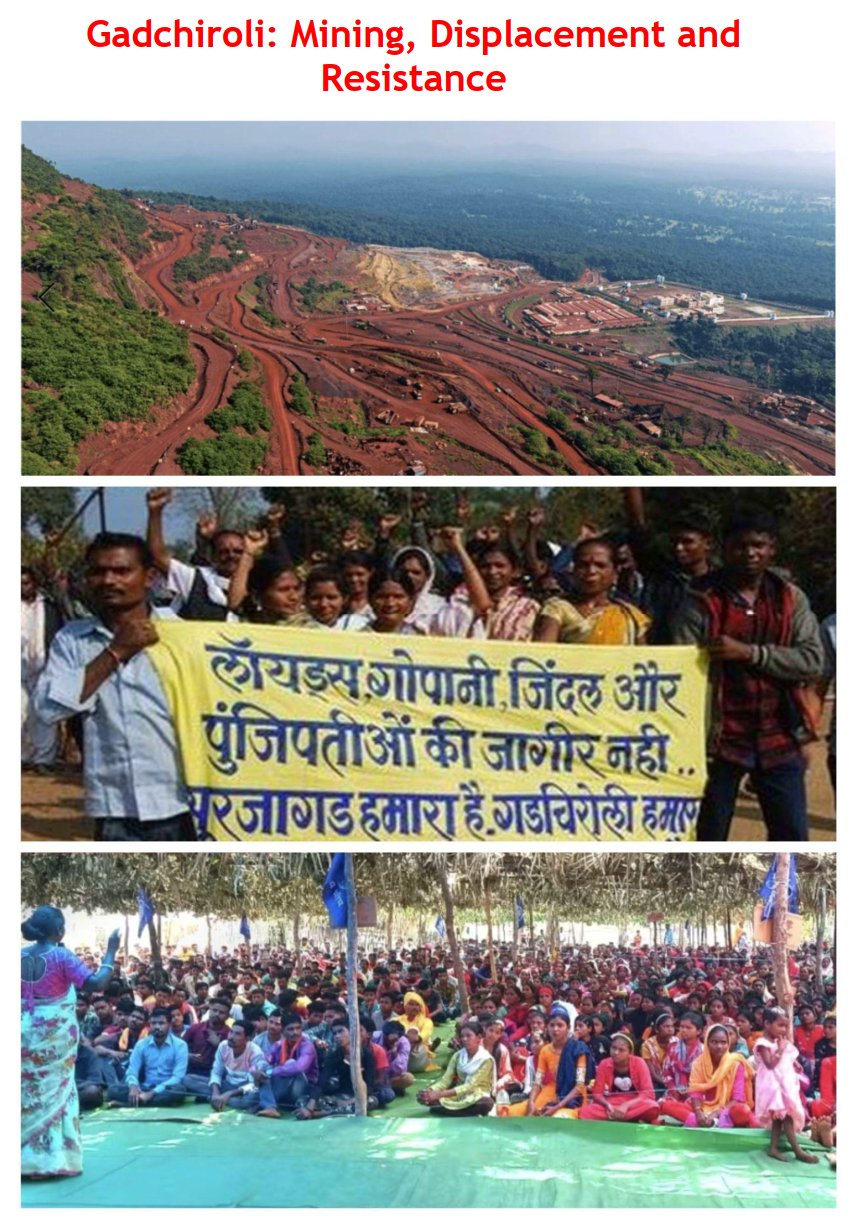
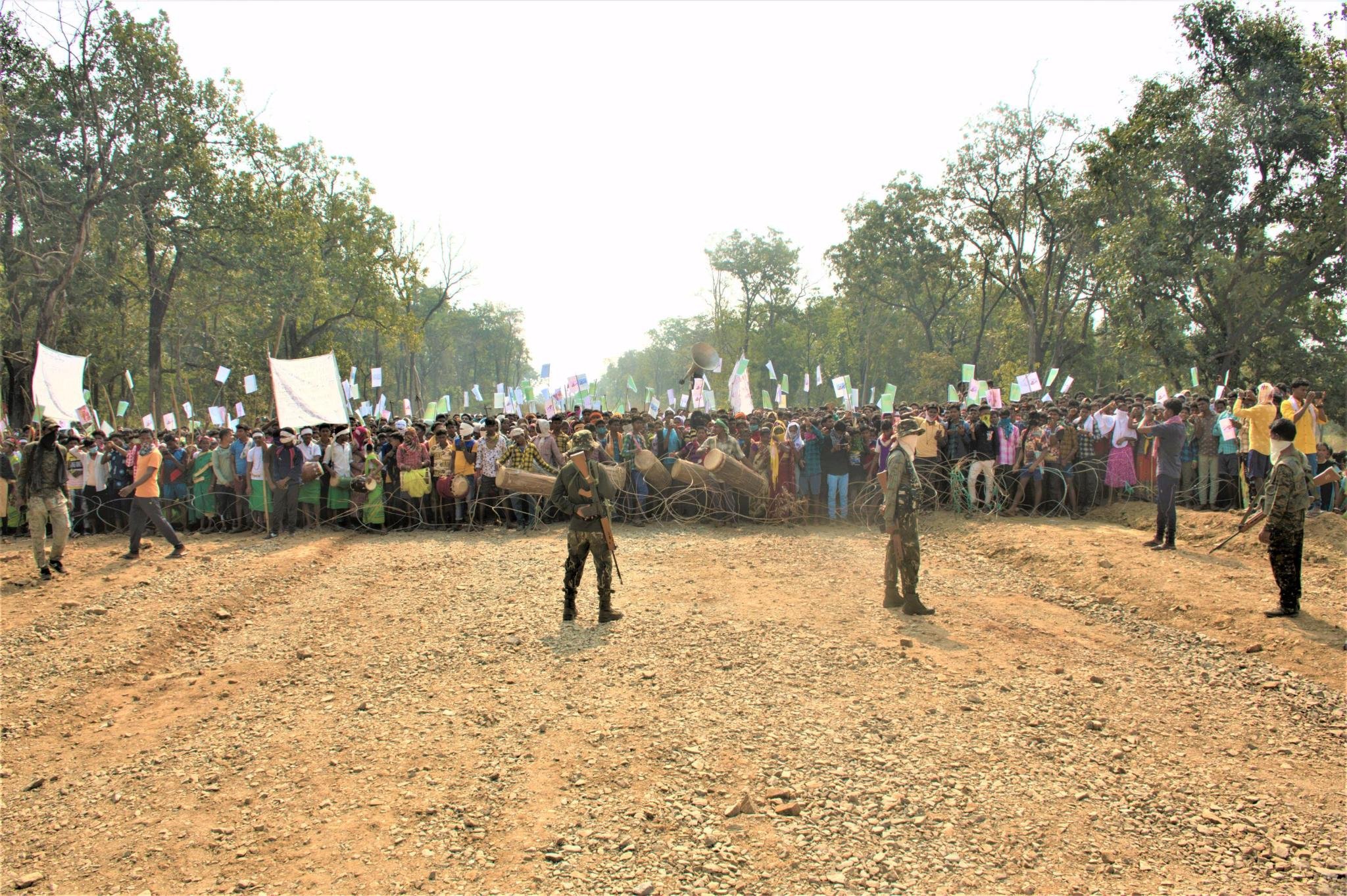
In this last session we heard from activists, lawyers, trade unionists from the Adivasi region of iron-rich Gadchiroli, Maharashtra about the situation there and how people are continuing to refuse their erasure by rampant deforestation and extraction projects by corporations such as Lloyd Metals. Understanding the situation in Gadchiroli will help us understand what might become the consequences from the state-corporate nexus, for Bastar and all Adivasi regions.
We also share our report of the situation in Gadchiroli. Just like Bastar, there is an urgent need to highlight the situation of Gadchiroli at national and international levels. Not only to raise voice on anti-mining and anti-displacement struggles, but also to create support mechanisms for release of all Adivasi and non-Adivasi prisoners for resisting developmental violence. Click on the link or image to access the report.
Finally, scroll below the glossary for suggested ways to bridge solidarities with Adivasi struggles in central and central-eastern India.
Email insafindia@protonmail.com for further information. We will try our best to answer questions.
GLOSSARY (in order of appearance in the video):
• Akhil Bhartiya Adivasi Mahasabha – All India Indigenous Peoples Grand Assembly
• Jal Jangal Jameen – Water Forests Lands
• PESA – Provisions of the Panchayats (Extension to Scheduled Areas) Act 1996
• FRA – the Scheduled Tribes and Other Traditional Forest Dwellers (Recognition of Forest Rights) Act, 2006
• Gram Sabha – the Adivasi village assembly in which all adults in a village participate
• MIDC – Maharashtra Industrial Development Corporation
• Taluka (Tehsil): an administrative and revenue unit
• Bhumiya – keeper of land records
• Perma – priest
• Gram Panchayat: village-level elected local governance body serving as the most basic-level administration unit in rural parts of India
• Panchayat Samiti – the next or intermediate body that functions at the ‘block’ level and coordinates ‘development’ activities across several villages
• Triveni Sangam – point of confluence of the Indravati, Pearl Kota, and Pamul Gautami rivers
• 28 July – the start of the annual ‘Martyrs Week’ of the proscribed Communist Party of India (Maoist), which had a strong presence in the Gadchiroli region for about 4 decades
• Tehsildar – land revenue official who may also function as executive magistrate (Class 1 gazetted officer). A tehsildar manages the administration and tax collection at tehsil level. • Patwari – works under the Tehsildar, keeps the accounts, land records etc.
• CAMPA – Compensatory Afforestation Fund Management and Planning Authority
• Chironji (a nut), amla (a sour berry), mahua (a flower), tendu (a leaf) – these are the most commonly found Minor Forest Produce (MFP) in Adivasi areas, the collection and selling of these seeds, fruits, flowers and leaves forms a significant economic practice of the Adivasi people
• Ken Betwa Project – A proposed river linking project that has raised huge concerns for the local Adivasi peoples of the Ken Betwa region in Madhya Pradesh. To learn more about their struggle see: Forest Rights Act under pressure in Madhya Pradesh; Ken Betwa Protests
• Rani Kamlapati – a heroic Gond Adivasi queen – the Indian government has been steadily appropriating various Adivasi heroes to appease them while also oppressing and displacing them
• Janjatiya Gaurav Divas – ‘Tribal Pride Day’ announced by the current Government of India led by the Bharatiya Janata Party. The day chosen for this celebration is 15 November, the birthday of the Adivasi revolutionary leader Birsa Munda. As pointed out by the participants in the webinar, the Indian state is appropriating Adivasi symbols of pride, honour and inspiration while continuing to oppress the communities, along with their displacement and dispossession
• CRPF – one of the several Central Armed Police Forces that are directly controlled by the Ministry for Home Affairs of India. These ‘paramilitary’ police forces are supplied with state-of-the-arms weapon and surveillance systems for internal repression of dissenting communities such as the Adivasis.
Some Suggestions for Building Global Solidarities with the Adivasi Anti-Mining, Anti-Displacement Resistance Movements in Central and Eastern India
Corporate accountability outside India Find out and initiate campaigns targeting the investors and supply chains of the companies that are operating in Adivasi regions: e.g. Arcelor Mittal (Bastar); Lloyds Metals (Gadchiroli), Vedanta (Niyamgiri), JSW (Gadchiroli), Sunflag (Gadchiroli), Adani Group (multiple sites across these regions); Lloyds Metals - Curtin University (Australia) partnership is one international link; the Adani Green sponsored ‘Energy Revolution’ in the Science Museum, London is another [will add hyperlinks to these].
Demand accountability Demand accountability for the extrajudicial killings, the enforced disappearances, arbitrary detention and other forms of state repression in the Adivasi areas and pursue international means of accountability wherever possible.
Document what the state does not For example, independent water and soil testing downstream of Surjagarh; a jobs audit (local, Adivasi, permanent vs contract); a census of community forest rights (CFR) overlap with leases, socio-economic and environmental conditions in areas where large mining corporations are functioning.
Amplify the Gram Sabha alternative modes of self-governance being practised in Adivasi regions The united Gram Sabha movement in various parts of Gadchiroli and their forest-based economical and self-governance system demonstrates a development model the communities themselves have chosen. .
Academic freedom link Researchers and journalists face restricted access to Etapalli in Gadchiroli, many areas in Bastar and so on; other organisations like InSAF India can try to support safe field documentation and publication.
Amplify Adivasi voices in youth spaces. Use the series and the forthcoming learning materials in your teaching if you are an academic.
Write a solidarity statement with the jailed Adivasi youth activists You can do this here: https://www.academicfreedomindia.com/solidarity-jailed-adivasi-youth-activists. Then share it on social media.
Deadline or Death Sentence ‘Book Club’ Each webinar is like a ‘book chapter’ that can be watched in advance of a group discussion. Decide an action at the end of the series – use our suggestions or think of more.
Make links. Between the Adivasi situation and resistance with other Indigenous struggles you support.
Image: ECCHR

Session 11: Resisting State Narratives Normalising Violence and Displacement in Adivasi Regions
(2:30 PM UTC/8:00 PM India/3:30 PM London/10.30 AM EST)

Session 10: The Indian State’s Attempts to Erase Indigenous Adivasi Cultures and Livelihoods Practices
(2:30 PM UTC/8:00 PM India/2:30 PM London/09.30 AM EST)

Session 9: Conservation Projects in Adivasi Areas: Another Face of Militarisation and Land Expropriation
(2:30 PM UTC/8:00 PM India/2:30 PM London/09.30 AM EST)

Session 8: International Legal Frameworks for Accountability
(2:30pm UTC/8:00 PM India/2:30 PM London/9.30 AM EST)

Session 7: Corporate Influence on the Indian State’s Policies and Actions in Adivasi Regions
(2:30pm UTC/8:00 PM India/2:30 PM London/9.30 AM EST)

Session 6: Scripting State Violence and Criminalisation of Resistance in India
(2:30pm UTC/8:00 PM India/3:30 PM London/10.30 AM EST
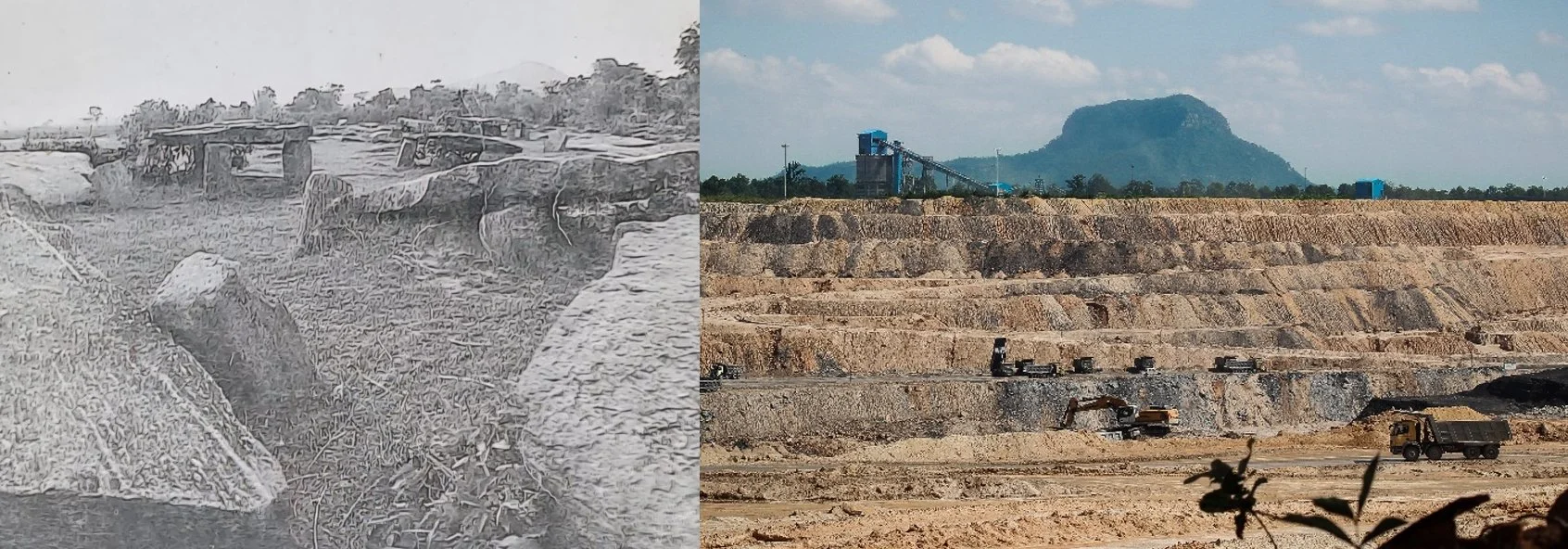
Session 5: Weaponising Land and Forest Legal Regimes for Sabotaging Indigenous (Adivasi) Land Rights in India
(2:30 PM UTC / 8pm Delhi / 3:30pm London / 10:30am New York)

Session 4: Towards the Deadline (2): The State as Agent of Corporate Capitalism
(2:30 PM UTC / 8pm Delhi / 3:30pm London / 10:30am New York)

Session 3: Courts as Instruments of State Power -Judicial Complicity in Indigenous Dispossession and Criminalisation in Adivasi Regions in India
(2:30 PM UTC / 8pm Delhi / 3:30pm London / 10:30am New York)
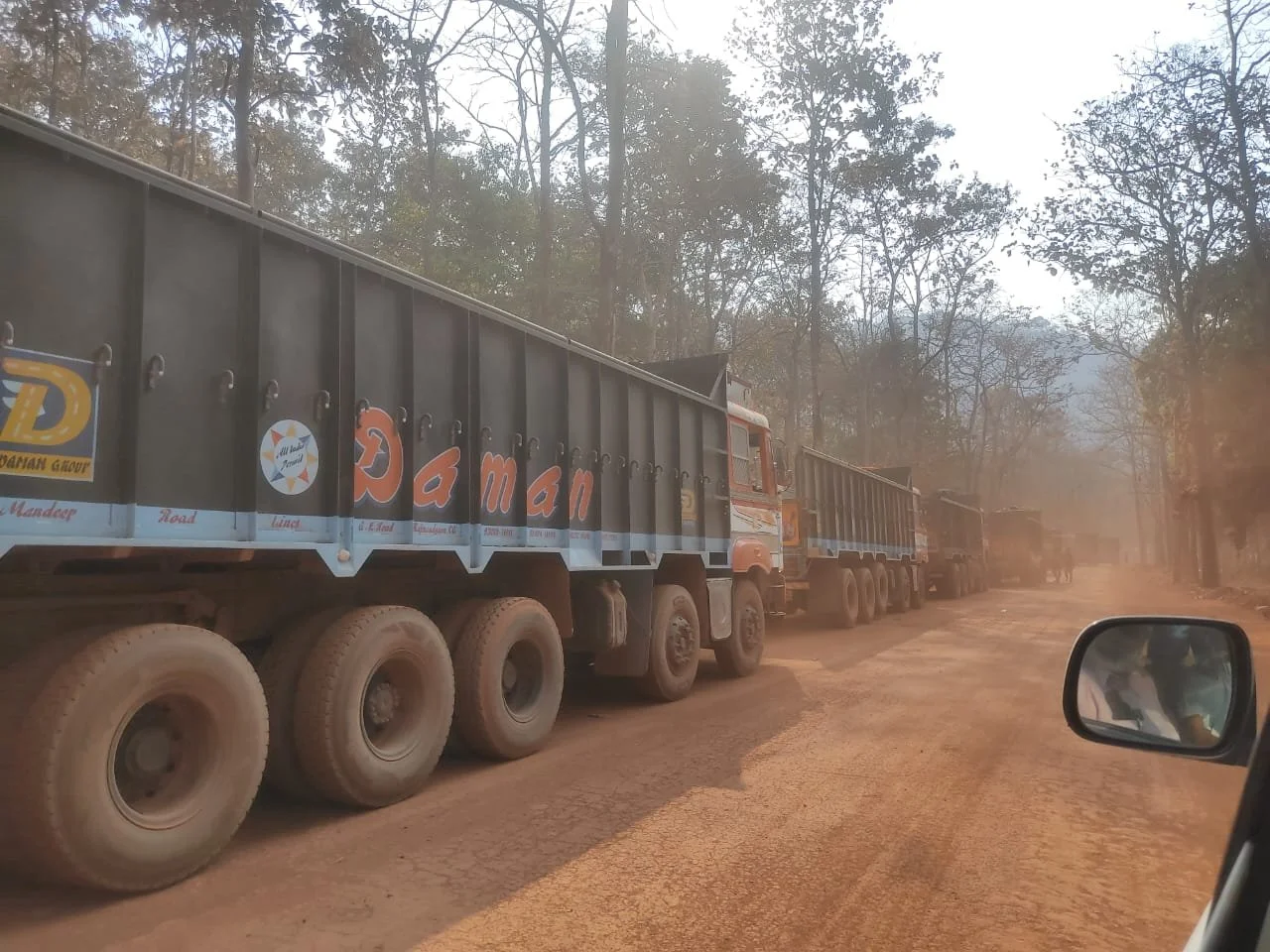
Session 2: Behind the Deadline (1): Resource Extraction and the State-Corporate Nexus
(2:30 PM UTC / 8pm Delhi / 3:30pm London / 10:30am New York)
Session 1: Understanding the Current Level of State Violence in the Lead Up to the ‘Deadline’
(2:30 PM UTC / 8pm Delhi / 3:30pm London / 10:30am New York)